Islamis Origin of Art Work Islamic Origin of Artwork
Islamic Art And Islamic Carpets in History
Throughout history, certain events left their mark on the evolution of the carpet manufacture and blueprint. The spread of Islam and the advent of Islamic fine art and the Islamic carpets is ane of those events that contributed to the beautiful patterns and colors that we enjoy today. Persian carpet design in item was greatly influenced by Islamic traditions.
The Origins Of Islam And The Islamic Earth
Islam began in the Arabian Peninsula, and over several hundreds of years, information technology spread throughout Espana, the Byzantine Empire, the Sasanian Empire and throughout Asia. "The Islamic world" refers to countries where the rulers and people adhere to the exercise of Islam. Although at that place is no specific criterion for inclusion, this world has expanded and contracted throughout history.
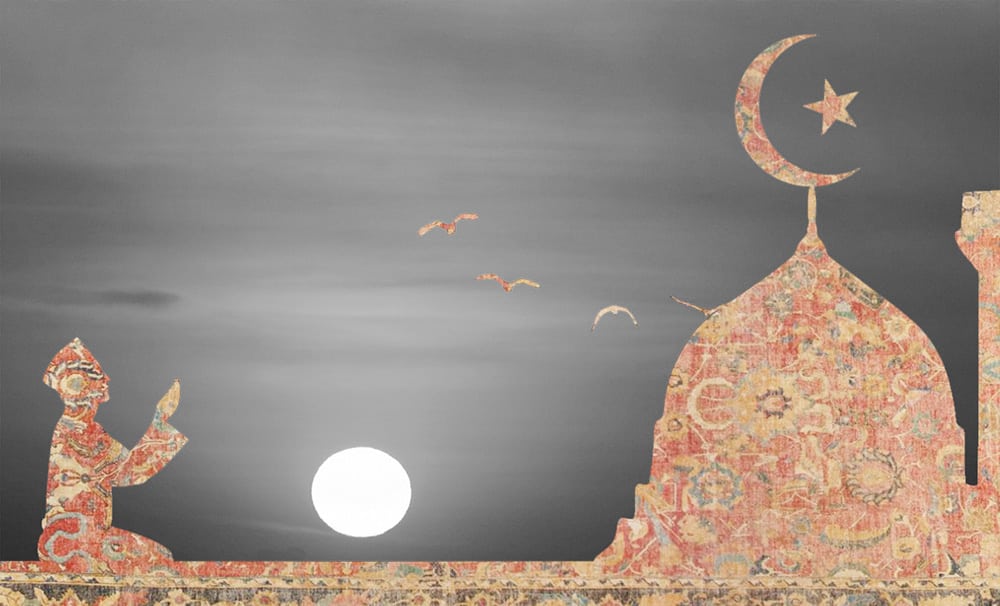
Antiquarian Islamic Carpets
As Islam spread into new areas, it meant that local culture and political changes were impacted. This naturally includes near every surface area of society and life including the arts.
History Of Islamic Art and Rugs
Islamic Fine art as a Way of Life
Looking at Islamic art, art enthusiasts will spot a common thread with four basic components: calligraphy, vegetative patterns, figurative representation and geometric patterns. When individuals expect at art of the Islamic faith, they will see information technology as more of a fashion of a life. Nonetheless, it'd be a bully error for someone to fault Islamic art every bit doing nothing more than giving a brandish of the Islamic faith because it has wonderful diversity to it, and a personality all of its own. Changes to the themes accept changed over time.
Distinguished Muslim Art
When most people think of the Middle East, they imagine some of the cornerstone pieces of Islamic fine art. For instance, the Muslim world has a characterization through its architecture, and the art in the land frequently came from many of its patrons. Muslim art became and then distinguished that it, in fact, became a civilization and language of its own. People will spot many new and unique artistic flavors reflected in the art and the compages of the Muslim world.
How The Islamic Arts Had Influences
The influences on Muslim fine art came from artists who worked under the Sasanian and the Byzantine empire. During this menstruation, a new era of art emerged as the work from some of the indigenous people of the region added their own unique style to the Muslim patrons. Some of the decorative themes with Islamic fine art can be identified in some of the earlier styles and techniques for blending the classics and adding the Iranian decorative theme. Many of the religious monuments had Islamic artists who worked on them. For instance, some of them were made during the Umayyad patronage, and information technology has a distinguished Islamic flavor. Ane instance of Islamic architecture shows itself in Jerusalem at an Islamic shrine called, "Dome of the Rock."
Umayyad Caliphate
The Umayyads were responsible for borrowing the architectural techniques from the Byzantines. The Dome of the Rock is the oldest surviving Islamic building built in 1023 subsequently it had collapsed. The Umayyads introduced many innovations to architecture, only during this time, their artistic flare became huge with the buildings they were constructing.
Punctuated past the Different Dynasties
Much of the art follows the precepts of Islamic history. Art experts divided the art based on the diverse dynasties. Some of the common distinctions include:
- Ottomans
- Safavids
- Mughals
I of the wonderful things related to Islamic art comes from the fact that individuals take many dissimilar regional and national styles that they can see. A great deal of diversity has been added to the art, and people can await at it over a period of fourth dimension to see how information technology evolved.
Islamic Art in Antiquarian Rugs: The most iconic Islamic art form and cultural tradition
Carpet weaving is the virtually iconic Islamic art form to come out of Islamic societies. This extraordinary tradition is well-nigh famous for producing the 'pile carpet' also known as the 'oriental carpet.' And so, predominantly you will observe the most sophisticated Islamic art in antique rugs.
In the late 16th century, Shah Abbas made an economic plan that gear up the rug weaving industry on burn. He did this by making trade treaties with Spain, England, and France. As a result, carpet weaving transformed from the hands of peasants to that of prestigious artists. Information technology was soon a national manufacture.
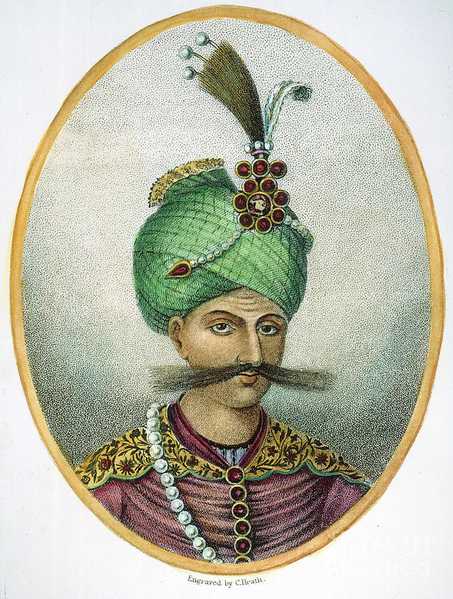
Shah Abbas, a historical force behind Islamic art and carpets.
Inside Islamic societies, the finest pieces were collected in majestic households, just they became caused by royalty outside of Islam as well. By the early on 17th century, Islamic rugs were being generated more than ever before and becoming a status symbol throughout European loftier gild households. These exquisite Islamic fine art pieces were too precious for the floor, and then they were usually used to decorate the walls or cover furniture.
As for the earliest Islamic carpets, most cease to exist. Of those that survived the ages, early scholars had to depend on Italian and Flemish paintings, particularly Renaissance paintings, to make up one's mind their birthdays. These historical paintings became a major source of information on early Islamic carpet weaving.
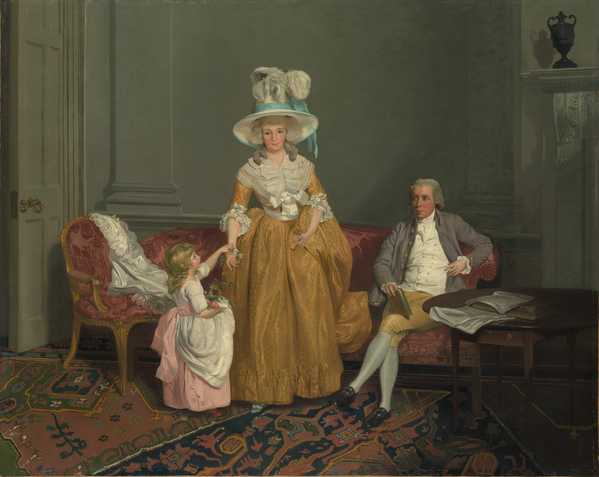
The Saithwaite Family unit by Francis Wheatley, Circa 1785
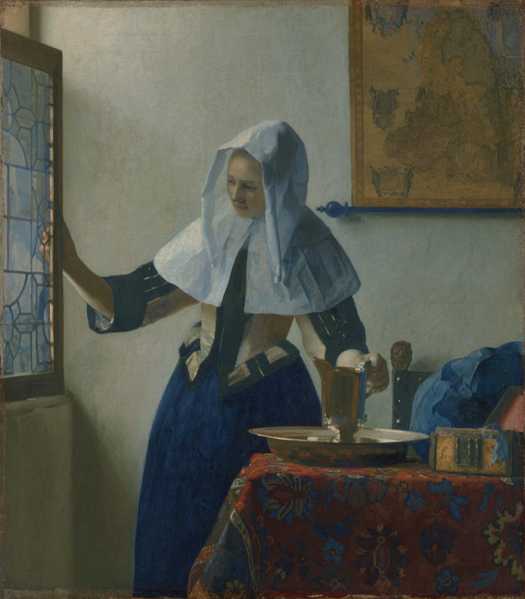
Young Woman with a Water Pitcher by Johannes Vermeer, Circa 1660-67
Moving frontward, rugs from the 17th century were identified from the clues the actual carpet provided, such as its type of dies, style, and design. Origin was often determined by the knot mode. For instance, Persian carpets were typically made with an asymmetrical knot while Turkish carpets were fabricated with the opposite.
In conclusion, antique rugs are a monumental part of Islamic Art History. They serve as expressive, decorative representations of Islamic history and a major entity in the earth's extraordinary history of art every bit a whole.
Islamic Carpets: From Cottage Industry to Fine Fine art
Throughout the Islamic world, women had been weaving carpets for thousands of years. They passed on their techniques and designs from one generation to the side by side. The introduction of Islam allowed the utilitarian practise of carpet weaving to drag to a art form in many areas of the world. The Islamic carpets were no longer only functional pieces of article of furniture. These magnificent objects were elevated into a symbol of status and wealth for their owners and were fabricated for the royal courts of the Islamic world.
Many of the traditional rug designs were nonetheless being produced in rural areas, only the introduction of Islam meant new patterns and the standardization of production methods. This was necessary to produce the exquisite courtroom rugs that plant their style into mosques, reception halls, and audience chambers. These antique rugs became a new class of artwork that catered to the wishes and needs of the ruling class.
New Islamic Carpet Patterns Under Islamic Rule
Changes in carpeting patterns reflected changes in the artwork found throughout the Islamic globe. For instance, Oriental rugs began to mimic the tiled geometric patterns that were institute in compages. Carpets began to be produced with a repeated motif in an all-over pattern throughout the entire field. Another style that made its way into carpets was the "saz" manner, which used flowers with stylized leaves that gracefully curved throughout the pattern.
The carpets began to develop into a garden of colors and shapes including a wide range of floral designs such every bit roses, carnations, hyacinths, tulips, lotus flowers, copse, and fruits. Secular art continued to exist produced, but new forms of religious art were added to the traditional local mixture of styles. This expanded the pattern possibilities in both the production centers of cities and villages.
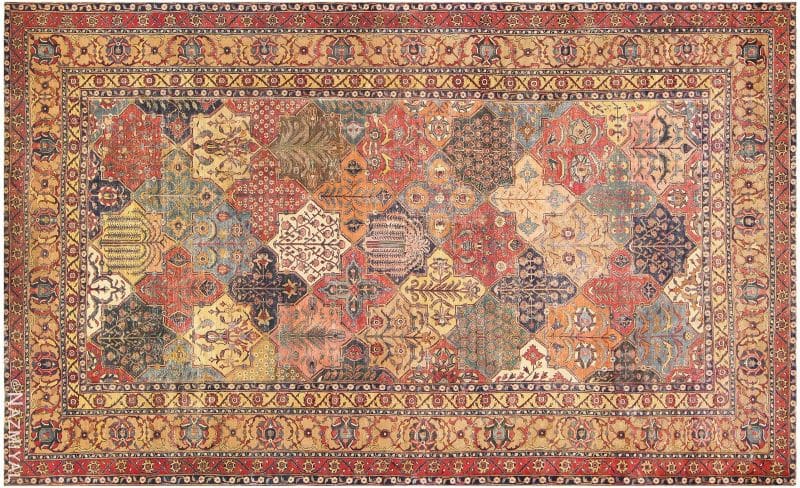
An example of a garden Islamic carpets with an all over design.
Inclusion of Calligraphy in Islamic Carpets
With the introduction of Islam, another chemical element that appeared was the introduction of calligraphy into the carpets. Calligraphy is a stylized rendition of phrases and words in a way that makes them into a beautiful piece of artwork. Sometimes this calligraphy may just look like it is Arabic writing when in fact, it is purely decorative.

Kufic Border Of Antiquarian Shirvan Carpeting
The calligraphy that actually has linguistic meaning, may include words or phrases from the Quran or possibly a piece of verse. Early forms of this calligraphy began to appear in the 1450'south. Words and phrases in stylized Arabic writing called "Kufic" were placed in the borders of the carpets. These would eventually be replaced by floral and saz motifs.
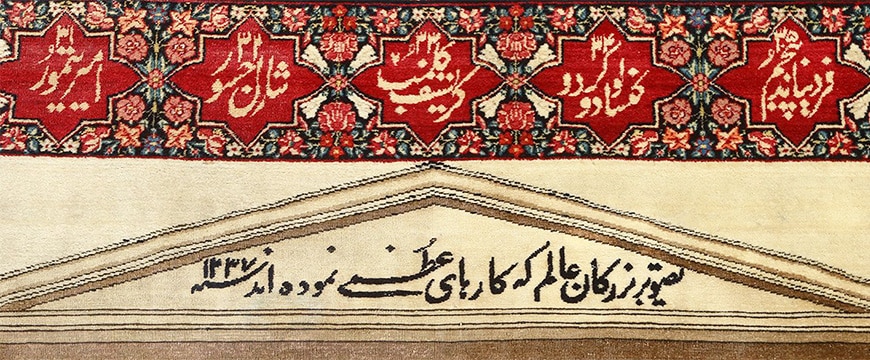
Antique Persian Mashahir Rug Carpeting With Calligraphy With Linguistic Meaning
The inclusion of calligraphy and other highly detailed motifs required the production of Islamic carpets that were finely woven and had a high knot density. The introduction of these elements meant improvements in the quality and processes for creating these fine carpets. It also meant that carpet weavers would need the ability to follow a given pattern, rather than reciting the patterns from retention. This shift represents the formalization of the artistic process that is used to create the carpets. Schools and weaving workshops were developed to teach blueprint and weaving for the production of these magnificently fine Court carpets.
The Introduction Of The Islamic Prayer Rugs
1 of the well-nigh important introductions of designs in carpet weaving under Muslim rule was the cosmos of Islamic prayer rugs. Prayer rugs are necessary for performing the 5 daily prayers that are required in the practice of Islam. These prayers are preferably performed in a mosque, but if at that place is no mosque available, they tin take place anywhere that has a clean surface and water for cleansing. The prayer rug provides a make clean surface to perform these prayers.
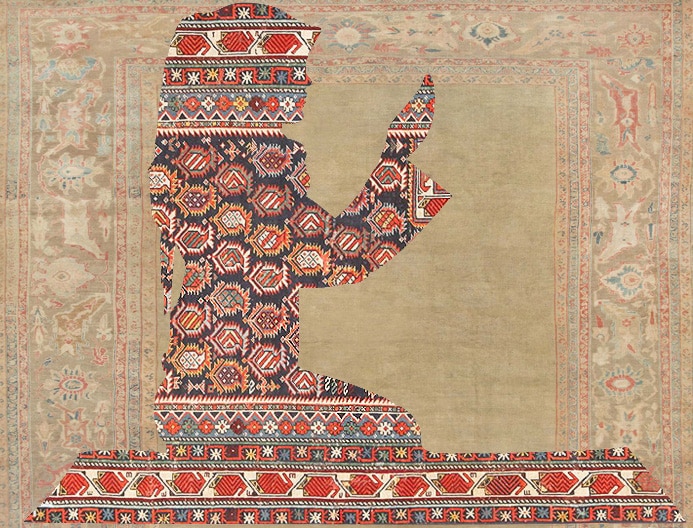
Muslim Prayer Rug
The introduction of Islam meant a new style of rug that is specifically designed for performing these prayers. These small size rugs that are easy to conduct, have a design chemical element known as the mihrab, or prayer niche. This type of carpet is used to correspond the mosque. It has a base and minaret on top, similar to those establish on the tops of mosques, where the call to prayer is issued. The top of the carpeting is placed towards Mecca for the recitation of the prayers. All practitioners are required to know the direction of Mecca, regardless of where they are in the world. These special carpets are an important function of the Islamic organized religion.
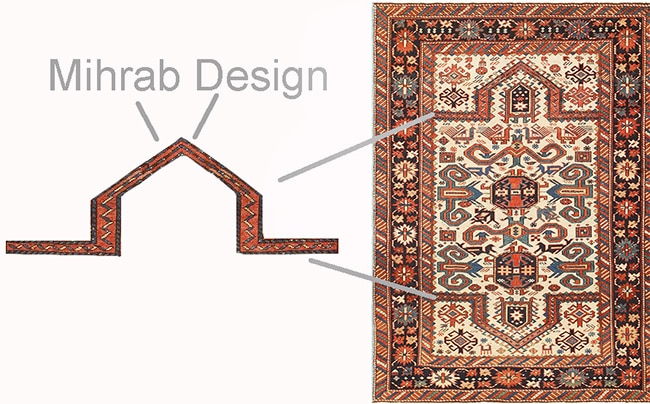
Mihrab Design in Islamic Muslim Antique Prayer Rugs
Islamic Mihrab design prayer carpets are highly ornate and have different designs that include florals, geometric, and sometimes, though very rarely, pictorial scenes. They are ornate just similar the mosques that they are meant to represent. You will often recognize many elements of compages in them, such as columns and arches. One time the prayers are said, the carpeting is carefully rolled up and treated as a sacred object. This careful treatment of this special grade of Islamic rugs means that nosotros have more of them in being from previous centuries than many other types of rugs.
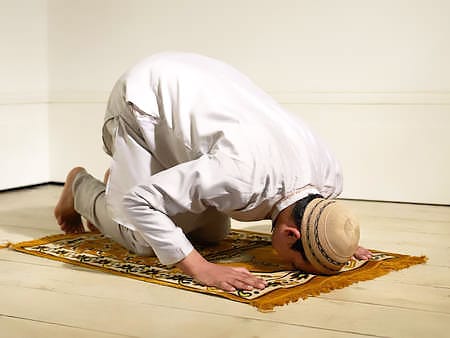
Muslim man praying on an Islamic prayer Rug
A New Islamic Artistic Philosophy
One of the differences between tribal rugs and Islamic Courtroom rugs is the representation of symbols and patterns. Many times, in the tribal carpets produced according to ancient traditions, these motifs and symbols had a specific significant that could exist understood by the viewer. It is much lik
e a primitive grade of writing. Nevertheless, in Islam, the motifs found in artwork practise not typically accept a specific meaning, but they exercise represent a certain philosophy.
One example of this is the utilize of tiled patterns in a carpeting. They are meant to bring beauty and harmony into the earth and reflect both the unity and diversity created by God. The symmetry reflects cosmic equilibrium and harmony. The carpet itself represents the impermanence of earthly objects in comparison to the higher guild of the heavens.
Some other do that one will detect in Islamic artwork is that when creating these tiled geometric shapes, in that location will exist an intentional mistake. This "fault" every bit an deed of humility to signal that nothing is perfect merely God. Sometimes this fault will be hidden, and other times, information technology will be quite obvious, depending on the preferences of the artist.
Representation of Plants and Animals
One of the tenants held by some of the more orthodox orders of Islam is a prohibition against making "graven" images. Still, i can discover many historical examples of carpets that depict plants, animals, and even people throughout areas that were under heavy Islamic influence at the fourth dimension the carpet was produced. The adherence to exercise depends on the mental attitude of the local ruler in accord with these tenets. This brings upward the point that the effects of Islam on art pattern were not evenly distributed and that local customs likewise played of import roles.
Some artists used abstractions of plants, animals, and human forms as a way of adherence to this prohibition. In sure areas this was considered adequate, and in others, even this was forbidden. Withal, this style gave rise to many new art forms and motifs. The influence of Islam was non compatible beyond all regions of the earth throughout its 1400 years of history. However, 1 seldom finds depictions of plants or animals on objects meant to be used for religious purposes. Many of these figures are constitute in secular rather than religious art in the Islamic world.
The spread of Islam throughout the world meant changes in all areas of society. The degree of these changes was dependent upon the orthodoxy that was adopted by the local rulers. It is essential to understand that the introduction of Islam meant an expansion of the arts and the introduction of new tools and motifs. In many areas, this immune the carpet weaving industry to move from a cottage industry to reach the status of fine art that it is today.
Patterns Inside Islamic Fine art
Thousands of years agone, a new art class was created to limited thoughts and feelings associated with Islam. This became the signature art form of a major religion, coming with it every bit information technology spread from country to land.
Islamic art is found in all throughout the Eye East, Arab republic of egypt, Morocco, and Spain. This unique art has a rich history and reflects the civilisation of Islam. It is used in both religious and non-religious settings. Islamic art features vibrant and complex patterns that convey sophistication and symmetry. About importantly, all of these different patterns are symbolic. Within these patterns we find shapes like stars, flowers, hexagons, and abstract shapes interacting with each other within intricate borders. Whether institute on rugs, tapestries, curtains, wallpapers, book covers, or anywhere else, it stands out as a style unlike whatever other.
Within Islam, there are many restrictions on actions in every area of life. This includes restrictions on what Islamic artists tin create and/or display. At that place is a concept called aniconism, which is basically the absence of material representations of humans and animals. Understanding and abiding past this concept is thought to forbid people from worshiping an epitome instead of worshiping God. Secular Islamic fine art sometimes includes humans and animals, but traditional Islamic art rarely does.
Islamic art is often found directly on a wall, on a canvas hanging on a wall, or as a ceramic. These are intricate and colorful, with a mix of geometric shapes and abstruse shapes. The beauty of Islamic art is not solely held in its appearance, but in its style of serving equally a symbol for ideas and concepts that are valued in Islamic civilization. Let's explore some cardinal characteristics of Islamic art, what influenced those characteristics, and some specific types of Islamic artwork.
Motifs are decorative designs or patterns. Floral motifs, geometric motifs, and calligraphy are the iii key characteristics of this fine art grade. Each of which is influenced by material plant in the Koran (Qur'an).
Floral Designs in Islamic Art
In Islamic art, floral designs are instead of humans and animals because floral designs symbolize growth and life. Floral designs can convey ideas about man life better than some people think they can. While sure types of flowers and plants have known religious meanings within Islam (such equally cypress copse, which often represent humility earlier God), the ones that practice not can exist used in Islamic art in ways that impart noesis of principles constitute within the Koran.
Timurid manuscripts, Ottoman tiles, and Safavid carpets often feature Islamic art. In the case of those three categories, the floral patterns will have flowers with four or five petals. Also the works of fine art featured on those items volition also have floral patterns that interlacing, rhythmic, and/or scrolling. Interlacing is besides called arabesque, this is when the shapes in the artwork look as though they are loosely or closely holding onto each other. Rhythm is created in visual art by the repetition of shapes and lines. It is easier to create a rhythmic pattern with geometric shapes than with flowers and plants. Scrolling refers to vines or curved lines that are placed in the artwork appearing tangled and/or continuous. To chief the creation of these designs, artists utilize techniques such as grids while also creating some of the designs completely freehand. With much practice, making the designs not bad and symmetrical is accomplished.
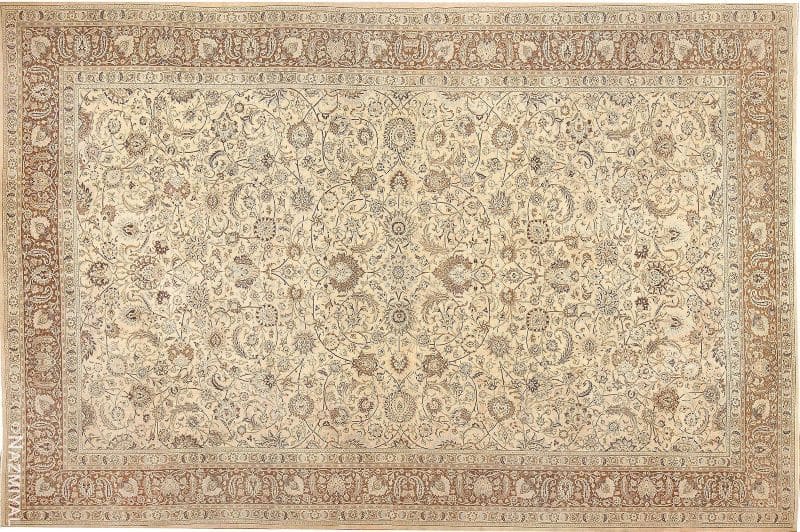
This Khorassan rug features an arabesque (aka Islimi) blueprint.
Geometric Patterns in Islamic Art
Geometry in Islamic fine art involves a multifariousness of unlike shapes that course patterns to reflect the linguistic communication of the universe. Metallic, paper, wood, drinking glass, carpeting, ceramics, and jewelry are but a few of the mediums where geometric patterns are ordinarily found. Geometric patterns often overlap with or form the framework for floral designs and calligraphy.
The 9th century marks the first of the use of stars in geometric patterns in Islamic art. Stars with 6 points and ones with xiii points emerged in patterns the 13th century. As time went on, Islamic artists continued to improve their techniques and apply stars with fifty-fifty more points.
Geometric designs focus on shapes and not-living objects.The complexities of geometric designs encourage viewers to examine them more than closely and think about their meanings. These designs are described as looping and scrolling because in fine art, lines and shapes convey motion. Upon looking at this kind of blueprint, the viewers eyes almost naturally motion around the artwork post-obit the unsaid motion of the objects in it. Similar other types of art, every viewer will take their own have on the pregnant of the design. It is interesting to encounter how unlike people perceive geometric designs.
Calligraphy in Islamic Fine art
Calligraphy is one of the key characteristics of Islamic fine art, and is said to be a way of celebrating and remembering God. Verses from the Koran are written into pieces of artwork in an expressive, harmonious, and rhythmic style. These are commonly establish on ceramics, metalwork, mosque walls, schoolhouse walls, and the walls of many other buildings in Islamic countries. These verses are usually written in Arabic, Persian, or Turkish.
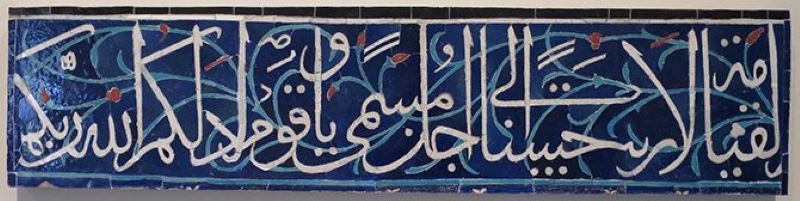
Calligraphy is nowadays in many forms of Islamic fine art.
Traditional Islamic art involving calligraphy is created with two different types of pens. Ane of the pens is called a galam and it is fabricated completely of natural wood. The other pen has a metallic tip. The mediums for this calligraphy are normally paper, tiles, vessels, carpets, or rock.
Take a look at some of our Islamic Prayer Rugs:
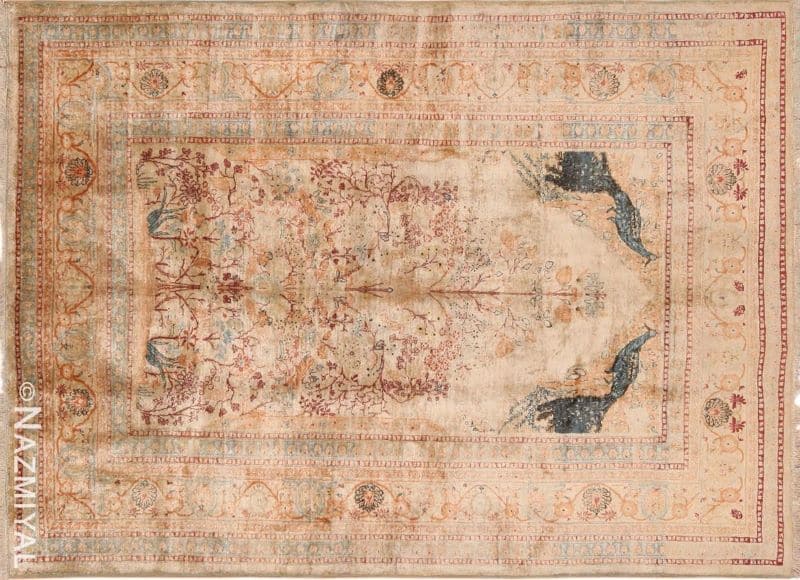
Antique Western farsi Tabriz Silk Prayer Rug
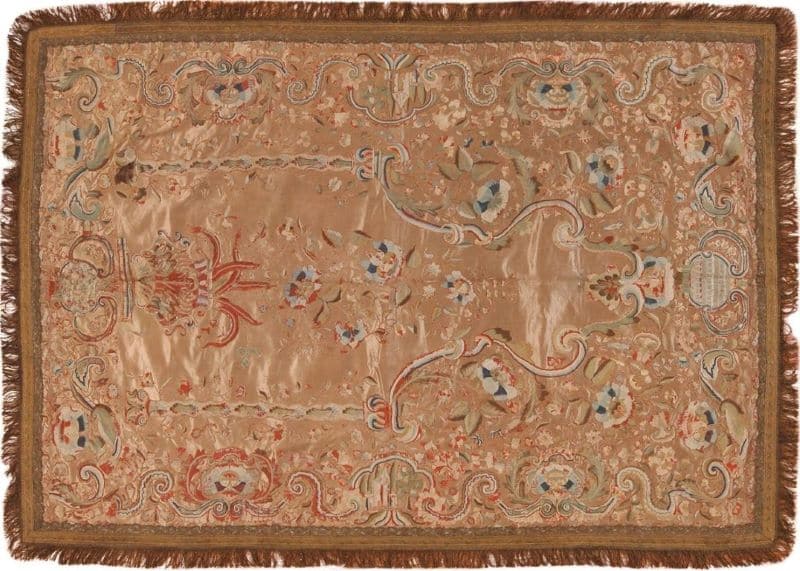
Antiquarian Persian Silk Embroidery Textile
This rug blog about the advent of the Islamic Fine art and Islamic carpets was published by Nazmiyal Antique Rug Gallery in NYC.
0 Response to "Islamis Origin of Art Work Islamic Origin of Artwork"
Post a Comment