Was There Ever Bomber With the Nose Art Bronx Bomber
| Bockscar | |
|---|---|
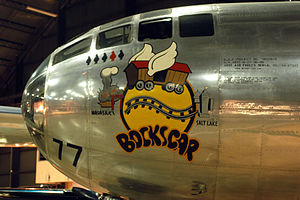 | |
| Bockscar nose art: the Fatty Human being silhouettes represent four pumpkin bomb missions (black) and the atomic bomb drop on Nagasaki (a red symbol, fourth in the line of v symbols) | |
| Type | B-29-36-MO Superfortress |
| Manufacturer | Glenn L. Martin Company, Omaha, Nebraska |
| Series | 44-27297 |
| Beginning flying | April 1945 |
| In service | 1945-1946 |
| Preserved at | The National Museum of the United States Air Force, Dayton, Ohio |
Bockscar , sometimes called Bock'south Car, is the name of the United states Army Air Forces B-29 bomber that dropped a Fat Man nuclear weapon over the Japanese city of Nagasaki during Globe War Two in the 2nd – and last – nuclear attack in history. 1 of 15 Silverplate B-29s used past the 509th, Bockscar was built at the Glenn L. Martin Aircraft Constitute at Bellevue, Nebraska, at what is now Offutt Air Strength Base of operations, and delivered to the The states Regular army Air Forces on 19 March 1945. It was assigned to the 393rd Bombardment Squadron, 509th Composite Group to Wendover Army Air Field, Utah in April and was named later on captain Frederick C. Bock.
Bockscar was used in 13 training and practise missions from Tinian, and three combat missions in which it dropped pumpkin bombs on industrial targets in Japan. On 9 Baronial 1945, Bockscar, piloted by the 393d Bombardment Squadron's commander, Major Charles W. Sweeney, dropped the "Fatty Man" nuclear bomb with a blast yield equivalent to 21 kilotons of TNT over the metropolis of Nagasaki. About 44% of the city was destroyed; 35,000 people were killed and 60,000 injured.
After the state of war, Bockscar returned to the United states of america in November 1945. In September 1946, it was given to the National Museum of the United States Air Forcefulness at Wright-Patterson Air Strength Base, Ohio. The aircraft was flown to the museum on 26 September 1961, and its original markings were restored (olfactory organ art was added after the mission).[i] Bockscar is now on permanent display at the National Museum of the United States Air Forcefulness, Dayton, Ohio, next to a replica of a Fat Human.
Aeroplane history [edit]

Bockscar at Dayton before information technology was moved indoors. On the Nagasaki mission, it flew without olfactory organ art, and with a triangle Northward tail mark, rather than the circle arrowhead shown here.

Bockscar with temporary triangle N tail marking, on 9 August 1945, the mean solar day of its atomic bombing mission
Bockscar, B-29-36-MO 44-27297, Victor number 77, was one of fifteen Silverplate B-29s used by the 393d Bombardment Squadron of the 509th Blended Group. Bockscar was built by the Glenn Fifty. Martin Visitor (later office of Lockheed Martin) at its bomber plant in Bellevue, Nebraska, located at Offutt Field, now Offutt Air Strength Base. A Cake 35 aircraft, it was i of ten modified as a Silverplate and re-designated "Block 36". [ii]
Silverplate involved extensive modifications to the B-29 to carry nuclear weapons. The bomb bay doors and the fuselage department between the flop bays were removed to create a unmarried 33-foot (ten chiliad) flop bay. British suspensions and bracing were attached for both shape types, with the gun-type suspension anchored in the aft bomb bay and the implosion type mounted in the forward bay. Weight reduction was too accomplished by removal of gun turrets and armor plating. These B-29s also had an improved engine, the R-3350-41. The Silverplate aircraft represented a significant increase in performance over the standard variants.[3]
Delivered to the U.S. Army Air Forces on 19 March 1945, Bockscar was assigned to Captain Frederick C. Bock and crew C-13, and flown to Wendover Regular army Air Field, Utah in April.[two] The name chosen for the aircraft, and painted on it later the mission, was a pun on the name of the aircraft commander.[4] It left Wendover on 11 June 1945 for Tinian, where it arrived 16 June. It was originally given the Victor (unit of measurement-assigned identification) number 7 but on 1 Baronial was given the triangle N tail markings of the 444th Bombardment Grouping as a security mensurate, and had its Victor changed to 77 to avoid misidentification with an actual 444th shipping.[5]
Bockscar was used in thirteen training and do missions from Tinian, and 3 combat missions in which information technology dropped pumpkin bombs on industrial targets in Japan, in which Bock's crew bombed Niihama and Musashino, and Kickoff Lieutenant Charles Donald Albury and crew C-xv bombed Koromo.[6]
Atomic flop mission [edit]
Mission and crew [edit]
Bockscar was flown on 9 Baronial 1945, by the crew of some other B-29, The Great Artiste, and piloted past Major Charles W. Sweeney, commander of the 393d Battery Squadron. The plane was co-piloted past Starting time Lieutenant Charles Donald Albury, the normal aircraft commander of Coiffure C-15.[7] The Not bad Artiste was designated as the observation, instrumentation support airplane for the second mission, and another B-29, The Big Stink, flown by group operations officer Major James I. Hopkins, Jr., as the photographic aircraft. The mission had equally its primary target the metropolis of Kokura, where the Kokura Armory was located. Its secondary target was Nagasaki, where two large Mitsubishi ammunition plants were located.[8]
Bockscar had been flown by Sweeney and crew C-15 in iii test drop rehearsals of inert Pumpkin bomb assemblies in the eight days leading upwards to the 2d mission, including the final rehearsal the 24-hour interval before.[9] The Great Artiste, which was the assigned aircraft of the crew with whom Sweeney near frequently flew, had been designated in preliminary planning to drop the second bomb, just the aircraft had been fitted with ascertainment instruments for the Hiroshima mission. Moving the instrumentation from The Dandy Artiste to Bockscar would have been a complex and time-consuming procedure, and when the second atomic bomb mission was moved up from eleven to nine Baronial because of adverse conditions forecasts, the crews of The Great Artiste and Bockscar instead exchanged aircraft. The consequence was that the bomb was carried by Bockscar merely flown by the crew C-15 of The Great Artiste.[10]
Kokura and Nagasaki [edit]
During pre-flight inspection of Bockscar, the flight engineer notified Sweeney that an inoperative fuel transfer pump made it impossible to use 640 US gallons (2,400 l; 530 imp gal) of fuel carried in a reserve tank. This fuel would still take to exist carried all the way to Japan and back, consuming even so more fuel. Replacing the pump would take hours; moving the Fat Human being to some other aircraft might have but as long and was dangerous as well, equally the flop was live. Group Commander Colonel Paul Tibbets and Sweeney therefore elected to have Bockscar keep the mission.[11] [12]
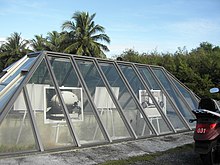
Preserved Tinian "bomb pit #two", where Fat Man was loaded aboard Bockscar
Bockscar took off from Tinian'due south North Field at 03:49.[13] The mission profile directed the B-29s to wing individually to the rendezvous signal, changed considering of bad weather condition from Iwo Jima to Yakushima Island, and at 17,000 feet (5,200 1000) cruising altitude instead of the customary 9,000 feet (2,700 m), increasing fuel consumption. Bockscar began its climb to the xxx,000 feet (9,100 m) bombing altitude a half-hour before rendezvous.[11] Before the mission, Tibbets had warned Sweeney to accept no more than fifteen minutes at the rendezvous earlier proceeding to the target. Bockscar reached the rendezvous point and assembled with The Great Artiste, only after circling for some time, The Big Stink failed to announced. As they orbited Yakushima, the weather planes Enola Gay (which had dropped the first atomic bomb on Hiroshima) and Laggin' Dragon reported both Kokura and Nagasaki within the accepted parameters for the required visual assault.[14] [15] [sixteen]
Though ordered not to circle longer than fifteen minutes, Sweeney continued to wait for The Big Stink, finally proceeding to the target merely at the urging of Commander Frederick Ashworth, the plane's weaponeer, who was in command of the mission.[17] Later on exceeding the original difference time limit by a one-half-hr, Bockscar, accompanied by the instrument plane,The Great Artiste, arrived over Kokura, thirty minutes away. The delay at the rendezvous had resulted in clouds and globe-trotting smoke from fires started past a major firebombing raid by 224 B-29s on nearby Yahata the previous day[18] roofing seventy% of the area over Kokura, obscuring the aiming bespeak. Three flop runs were made over the next 50 minutes, burning fuel and exposing the aircraft repeatedly to the heavy defenses of Yahata, only the bombardier was unable to drib visually. By the time of the third bomb run, Japanese anti-aircraft fire was getting close, and First Lieutenant Jacob Beser, who was monitoring Japanese communications, reported activity on the Japanese fighter direction radio bands.[19]

The mushroom cloud every bit seen from one of the B-29s on the mission
The increasingly critical fuel shortage resulted in the decision by Sweeney and Ashworth to reduce power to conserve fuel and divert to the secondary target, Nagasaki. The arroyo to Nagasaki twenty minutes later indicated that the middle of the city's downtown was also covered past dense cloud. Ashworth decided to flop Nagasaki using radar, but, according to Bockscar's bombardier, Captain Kermit Beahan, a modest opening in the clouds at the stop of the three-minute bomb run permitted him to place target features. Bockscar visually dropped the Fat Human being at 10:58 local fourth dimension.[xv] It exploded 43 seconds later with a blast yield equivalent to 21 kilotons of TNT at an altitude of 1,650 anxiety (500 m), approximately 1.5 miles (2.four km) northwest of the planned aiming betoken, resulting in the destruction of 44% of the city.[xx]
The failure to drib the Fat Man at the precise flop aim betoken acquired the atomic blast to be confined to the Urakami Valley. Every bit a upshot, a major portion of the city was protected by the intervening hills, just even so, the flop was dropped over the metropolis's industrial valley midway between the Mitsubishi Steel and Artillery Works in the southward and the Mitsubishi-Urakami Ordnance Works in the north. An estimated 35,000 people were killed and 60,000 injured during the bombing at Nagasaki.[21] Of those killed, 23,200–28,200 were Japanese munitions workers, 2,000 were Korean slave laborers, and 150 were Japanese soldiers.[22] [23] [24]
Landing and debriefing [edit]
Because of the delays in the mission and the inoperative fuel transfer pump, the B-29 did non take sufficient fuel to achieve the emergency landing field at Iwo Jima, and so Sweeney flew the aircraft to Okinawa. Arriving there, he circled for 20 minutes trying to contact the control belfry for landing clearance, finally concluding that his radio was faulty. Critically depression on fuel, Bockscar barely made it to the track at Yontan Airfield on Okinawa. With only enough fuel for one landing attempt, Sweeney and Albury brought Bockscar in at 150 miles per hour (240 km/h) instead of the normal 120 miles per hour (190 km/h), firing distress flares to alert the field of the uncleared landing. The number two engine died from fuel starvation as Bockscar began its final approach. Touching the runway difficult, the heavy B-29 slewed left and towards a row of parked B-24 bombers before the pilots managed to regain command. The B-29'due south reversible propellers were insufficient to slow the aircraft fairly, and with both pilots standing on the brakes, Bockscar made a swerving 90-degree turn at the cease of the rail to avoid running off the runway. A second engine died from fuel burnout by the time the aeroplane came to a stop. The flying engineer later measured fuel in the tanks and concluded that less than five minutes full remained.[25]
Post-obit the mission, at that place was defoliation over the identification of the plane. The first eyewitness account by state of war correspondent William L. Laurence of The New York Times, who accompanied the mission aboard the aircraft piloted past Bock, reported that Sweeney was leading the mission in The Smashing Artiste. However, he likewise noted its "Victor" number every bit 77, which was that of Bockscar, writing that several personnel commented that 77 was also the jersey number of the football game player Scarlet Grange.[26] Laurence had interviewed Sweeney and his crew in depth and was aware that they referred to their airplane as The Great Artiste. Except for Enola Gay, none of the 393d'southward B-29s had yet had names painted on the noses, a fact which Laurence himself noted in his account, and unaware of the switch in aircraft, Laurence assumed Victor 77 was The Dandy Artiste.[4] In fact, The Great Artiste was Victor 89.[27]
Electric current status [edit]
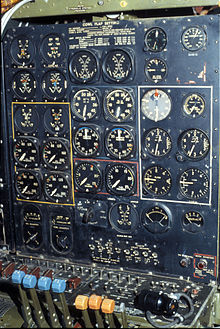
After the war, Bockscar returned to the U.s.a. in Nov 1945 and served with the 509th at Roswell Army Air Field, New Mexico. It was nominally assigned to the Operation Crossroads task force, just in that location are no records indicating that it deployed for the tests. In August 1946, information technology was assigned to the 4105th Army Air Forcefulness Unit at Davis-Monthan Army Air Field, Arizona, for storage.[ii]
At Davis-Monthan information technology was placed on display as the aircraft that bombed Nagasaki, but in the markings of The Neat Artiste. In September 1946, title was passed to the Air Strength Museum (now the National Museum of the United States Air Force) at Wright-Patterson Air Force Base, Ohio. The aircraft was flown to the museum on 26 September 1961,[28] and its original markings were restored.[2] Bockscar is now on permanent display at the National Museum of the United states of america Air Force, Dayton, Ohio. This display, a chief exhibit in the museum's Air Power gallery, includes a replica of a Fat Homo bomb and signage that states that information technology was "The aircraft that ended WWII".[29]
In 2005, a short documentary was made near Charles Sweeney'due south recollections of the Nagasaki mission aboard Bockscar, including details of the mission grooming, titled Nagasaki: The Commander'due south Vocalism.[30]
Crew members [edit]
Regularly assigned crew [edit]
Coiffure C-13 (manned The Great Artiste on the Nagasaki mission):[26] [31]
- Captain Frederick C. Bock, aircraft commander, Greenville, Michigan
- Commencement Lieutenant Hugh Cardwell Ferguson, Sr., co-pilot, Highland Park, Michigan
- Showtime Lieutenant Leonard A. Godfrey, Jr., navigator, Greenfield, Massachusetts
- Commencement Lieutenant Charles Levy, bombardier, Philadelphia, Pennsylvania
- Principal Sergeant Roderick F. Arnold, flying engineer, Rochester, Michigan
- Sergeant Ralph D. Belanger, assistant flight engineer, Thendara, New York
- Sergeant Ralph D. Back-scratch, radio operator, Hoopeston, Illinois
- Sergeant William C. Barney, radar operator, Columbia City, Indiana
- Sergeant Robert J. Stock, tail gunner, Fort Wayne, Indiana
Nagasaki mission crew [edit]

Crew C-xv. front row: Dehart, Kuharek, Buckley, Gallagher, Spitzer; back row: Olivi, Beahan, Sweeney, Van Pelt, Albury
Crew C-15 (normally assigned to The Great Artiste):[26] [32]
- Major Charles West. Sweeney, aircraft commander, N Quincy, Massachusetts
- Captain Charles Donald "Don" Albury, co-pilot (pilot of Crew C-fifteen), Miami, Florida
- Second Lieutenant Frederick "Fred" J. Olivi, regular co-airplane pilot, Chicago, Illinois
- Captain James F. Van Pelt, Jr., navigator, Oak Hill, West Virginia
- Captain Kermit K. Beahan, bombardier, Houston, Texas
- Master Sergeant John D. Kuharek, flying engineer, Sharpsburg, Pennsylvania
- Staff Sergeant Raymond C. Gallagher, gunner, assistant flight engineer, Chicago, Illinois
- Staff Sergeant Edward Thou. Buckley, radar operator, Lisbon, Ohio
- Sergeant Abe 1000. Spitzer, radio operator, Bronx, New York
- Sergeant Albert T. "Pappy" DeHart, tail gunner, Plainview, Texas
Also on board were the post-obit additional mission personnel:[26] [33]
- Commander Frederick Ashworth, USN, weaponeer
- Lieutenant Philip Thou. Barnes, USN, banana weaponeer
- Start Lieutenant Jacob Beser, radar countermeasures, Baltimore, Maryland (Beser flew on both atomic missions, serving equally the radar countermeasures crewman on the Enola Gay on 6 August 1945 and on Bockscar on 9 Baronial 1945).
National Museum of the United States Air Strength brandish [edit]


Notes [edit]
- ^ Official USAAF photo dated 11 August 1945, two days subsequently mission shows the aircraft with no nose fine art. See "photograph". National Museum of the US Air Strength. Retrieved vi May 2017. at "Boeing B-29 Superfortress". National Museum of the United states of america Air Force. Retrieved six May 2017.
- ^ a b c d Campbell 2005, pp. 172–173.
- ^ Campbell 2005, pp. eight–fifteen.
- ^ a b Campbell 2005, p. 222.
- ^ Campbell 2005, p. 19.
- ^ Campbell 2005, pp. 113, 139, 142.
- ^ "Charles Donald Albury dies at 88; copilot on the Nagasaki bomb plane". Los Angeles Times. 9 June 2009. Retrieved 29 March 2013.
- ^ Sweeney, Antonucci & Antonucci 1997, pp. 193–195.
- ^ Campbell 2005, pp. 113–114.
- ^ "Reflections from above". Academy of Wisconsin–Oshkosh. Retrieved 9 May 2007.
- ^ a b Sweeney, Antonucci & Antonucci 1997, pp. 204–205.
- ^ "The Story of Nagasaki". Retrieved 29 March 2013.
- ^ Chicken & Cate 1953, p. 719.
- ^ Sweeney, Antonucci & Antonucci 1997, pp. 210–211.
- ^ a b Chicken & Cate 1953, p. 720.
- ^ Campbell 2005, p. 30.
- ^ Bradbury, Ellen; Blakeslee, Sandra (iv August 2015). "The Harrowing Story of the Nagasaki Bombing Mission". Bulletin of the Atomic Scientists. Retrieved 10 November 2020.
- ^ Kleeman, Sophie (29 July 2014). "The Untold Story of How Japanese Steel Workers Saved Their City From the Atomic Bomb". Mic. Retrieved 10 November 2020.
- ^ Sweeney, Antonucci & Antonucci 1997, pp. 179, 213–215.
- ^ Wainstock 1996, p. 92.
- ^ Groves 1962, p. 346.
- ^ Nuke-Rebuke: Writers & Artists Against Nuclear Energy & Weapons (The Gimmicky anthology series). The Spirit That Moves Us Press. 1 May 1984. pp. 22–29.
- ^ Groves 1962, pp. 343–346.
- ^ Hoddeson et al. 1993, pp. 396–397.
- ^ Sweeney, Antonucci & Antonucci 1997, pp. 222–226.
- ^ a b c d Laurence, William Fifty. "Eyewitness Account of Atomic Bomb Over Nagasaki". National Science Digital Library. Retrieved 28 March 2013.
- ^ Campbell 2005, p. 184.
- ^ "Boeing B-29 Superfortress". United states of america Air Force. Archived from the original on 24 January 2015. Retrieved 29 March 2013.
- ^ "Bockscar: The aircraft that concluded WWII". United States Air Strength. Archived from the original on 23 March 2013. Retrieved 29 March 2013.
- ^ "Nagasaki". Michael Puttré. Archived from the original on 3 January 2013. Retrieved 29 March 2013.
- ^ Campbell 2005, p. 138.
- ^ Campbell 2005, pp. 141–142.
- ^ "The Story of Nagasaki". National Scientific discipline Digital Library. Retrieved 28 March 2013.
References [edit]
- Campbell, Richard H. (2005). The Silverplate Bombers: A History and Registry of the Enola Gay and Other B-29'due south Configured to Conduct Diminutive Bombs. Jefferson, North Carolina: McFarland & Company, Inc. ISBN978-0-7864-2139-viii.
- Craven, Wesley; Cate, James (1953). "Victory". In Chicken, Wesley; Cate, James (eds.). The Pacific: Matterhorn to Nagasaki. The Army Air Forces in World War Two. Book V. Chicago: The University of Chicago Press. pp. 703–758. OCLC 256469807. Retrieved 29 March 2013.
- Groves, Leslie (1962). Now information technology Can be Told: The Story of the Manhattan Projection . New York: Harper & Row. ISBN978-0-306-70738-4. OCLC 537684.
- Hoddeson, Lillian; Henriksen, Paul W.; Meade, Roger A.; Westfall, Catherine L. (1993). Critical Assembly: A Technical History of Los Alamos During the Oppenheimer Years, 1943–1945 . New York: Cambridge University Printing. ISBN978-0-521-44132-2. OCLC 26764320.
- Sweeney, Charles; Antonucci, James A.; Antonucci, Marion Grand. (1997). War'south End: an Eyewitness Account of America's Terminal Atomic Mission . New York: Avon Books. ISBN978-0-380-97349-1.
- Wainstock, Dennis D. (1996). The Decision to Drop the Atomic Flop. Praeger Publishing. ISBN978-0-275-95475-8.
External links [edit]
 | Wikimedia Commons has media related to Bockscar. |
- Reflections from above: Fred Olivi's perspective on the mission which dropped the atomic flop on Nagasaki
- White Light/Black Rain Official Website (picture show)
- Records of the Nagasaki Atomic Bombing
Coordinates: 39°46′55″N 84°06′32″W / 39.781976°North 84.108892°West / 39.781976; -84.108892
Source: https://en.wikipedia.org/wiki/Bockscar
0 Response to "Was There Ever Bomber With the Nose Art Bronx Bomber"
Post a Comment